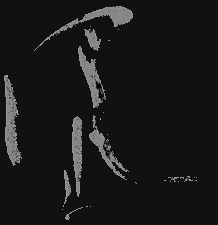
零式写真美術の位置づけ ― 「非在と顕れの境界としての構造的閾値」
- cogito ergo sum

- 2025年11月13日
- 読了時間: 4分
更新日:2025年12月14日
いわゆる写真美術とは、写真という媒体を通して表現される美術の一領域である。そこでは、作品や作者という枠組みのもと、社会的評価や制度的承認といった人間的欲求が「美術」として定義されている。つまり、写真美術は美術体系の内部に属し、評価や流通を前提とした文化的装置の一部として存在している。
一方、零式(Zero-horizon)は、この体系の外側にある【🔧調整】「制度以前の地点に着目する思考」 と構造的な隣接性をもつ。限界芸術とは、芸術の中心的制度から距離を取り、創造の起点を制度や評価の外部に見いだそうとした思想である。零式は、この姿勢を参照しつつも、その射程をさらに押し広げ、世界そのものが成立する以前の構造的地平(horizon) を扱う理念である。
零式が据える“0(ゼロ)”とは、単なる「無」ではない。それは、存在と非存在が分岐する以前に保たれている未分化の均衡状態 を指す。存在が消えゆく瞬間に現れる情緒的気配ではなく、世界がいまだ意味や主体を持たずに持続している構造的な閾値としての「0」である。
この零の地平において生じるのは、秩序と混沌、静と動のいずれにも確定しない構造的偏位 である。ここで言う「ゆらぎ」とは、感情や感受の揺れではなく、世界が自己を固定化する以前に示す最小限の変位のリズムを指す。
人間が後に「もののあはれ」と名づけてきた感受は、この構造的偏位が主体側に届いたとき、写道という行法を通して立ち上がる事後的な情緒経験 にほかならない。
したがって、零式写真美術とは、「ゆらぎ」や「もののあはれ」を直接表現するための体系ではない。それは、世界の前相構造において生じた偏位と応答が、写真という装置を通じて一回的に痕跡化された結果として成立する。
零式写真美術は、作品を「表現」として提示するための技法体系ではなく、世界の生成が可視的形態を許容した痕跡の配置 である。撮る者は共鳴する主体ではなく、写道によって作為を消去し、世界の応答が立ち上がる条件を整える存在にすぎない。
写真がここで芸術となるのは、意図や評価によってではなく、世界の生成構造が一度だけ可視化を許したその瞬間に立ち会ったという事実によってである。
零式写真美術とは、「無」と「存在」のあわいにある世界の構造が、一回的に痕跡として残された生成の地平なのである。
Zero-Horizon Photographic Fine Art
A Structural Threshold Between Non-Being and Appearance
What is conventionally called photographic fine art refers to a domain of art expressed through the photographic medium.Within this framework, works and authors are defined through systems of social evaluation and institutional recognition, where human desires for visibility, validation, and circulation are formalized as “art.”Photographic fine art, in this sense, belongs to the interior of the art system and functions as part of a cultural apparatus premised on assessment and distribution.
Zero-Horizon, by contrast, does not originate within this system.It maintains a structural adjacency to modes of thought that have sought points prior to institutionalization, including what has historically been described as Marginal Art.Marginal Art distanced itself from central artistic institutions in order to locate creative activity at the threshold where existence and non-existence appear to touch.Zero-Horizon refers to this orientation, yet extends its scope further—toward the structural horizon that precedes the formation of the world itself.
The “zero” posited by Zero-Horizon does not signify mere nothingness.It denotes an undifferentiated state of equilibrium, prior to the division of being and non-being.This zero is not an affective trace perceived at the moment of disappearance, but a structural threshold in which the world persists before meaning, subjectivity, or form have emerged.
Within this zero-horizon, what arises is neither order nor chaos, neither stillness nor motion, but a minimal structural deviation.The “fluctuation” spoken of here does not describe emotional instability or sensory wavering.It refers instead to the world’s most elementary deviation prior to fixation—a rhythmic displacement through which the world remains open to emergence.
What humans have historically named mono no aware does not belong to this structural layer itself.It appears only afterward, when such structural deviation reaches the subject through the disciplined practice of Shadō, manifesting as an experiential or affective response.In this sense, emotion is not foundational but derivative, arising on the side of the subject.
Accordingly, Zero-Horizon Photographic Fine Art is not a system designed to express “fluctuation” or mono no aware directly.It is the result of a one-time trace, produced when a deviation and response within the world’s pre-phenomenal structure are permitted to appear through the photographic apparatus.
Zero-Horizon Photographic Fine Art is not a technique for presenting expression.It is the placement of a trace—a visible form that the world momentarily allows to surface as a consequence of its own generative structure.The photographer does not function as a resonating subject, but as one who, through Shadō, eliminates excessive intention and prepares the conditions under which the world’s response may emerge.
Photography becomes art here not through intention or evaluation, but through the fact that one has stood at the moment when the world’s generative structure permitted visibility to occur once.
Zero-Horizon Photographic Fine Art thus designates a horizon of art in which the structure of the world—situated between non-being and being—has been left as a single, irreducible trace of generation.


コメント